
Friday, March 15, 2013
Gary Robbins Time!
We're excited to announce that our friendly and fast neighbor to the north, Gary Robbins, will be joining us over Memorial Day for an undoubtedly inspiring and fun presentation on his entry to and rise in ultra running. Gary currently runs for Salomon Running and holds several course records, including the gnarly HURT 100 miler. He challenges himself on solo adventure runs as well, and has fast known times to his credit, including the West Coast Trail of BC and the East Coast Trail of Newfoundland. Aside from his accomplishments, Gary is one of the nicest, most humble runners I know (and owns the second best running dog in the world). We invite you to spend an evening (after doing the Mazama 5/10k, of course) learning how Gary became one of the best in the sport (it may surprise you); then watch a documentary on his experience setting the speed record on the East Coast Trail. We'll be raffling off some shwag from our wonderful sponsors, as well. We hope to see you there!

Friday, March 8, 2013
Interval Training - NOT a magic bullet
Chances are if you've ever been wandering through your local sports shop, browsing the latest bonded-seam bun-hugging compression shorts, you've overheard a couple endurance enthusiasts whispering conspiratorially about intervals. Perhaps it was their last session together, when they pushed to complete exhaustion in a 6x4min L4 workout up Mad Turtle Hill or some other notorious local proving ground. Point being, intervals are forefront on the mind of aspiring and experienced endurance athletes alike. But does the substance live up to the hype?
 |
| Your typical endurance athlete |
"To
find the origins of the special form of repetition training known as
Interval Training we must go back in history, over 70 years to the
late 1930s. At that time a German coach, Dr. Woldemar
Gerschler...carried out experiments in the form of repetition
training where an athlete would run over a relatively short distance,
such as 200m, at a relatively fast pace, a number of times. The name
of the system, 'Interval Training', was because the rest or recovery
period between the faster runs was considered the most important and
vital part of the training. It is during the interval that the heart
adapts, growing larger and stronger. " (Thompson,
http://www.newintervaltraining.com/old-interval-training.php)
And
even earlier, we can turn to the Swedes, who invented "fartlek"
("speed play") training, which involves a more liberated
approach to intensity, allowing the athlete to modulate the speed and
effort during on-times, and also adjusting them to fit terrain,
especially in locales lacking a track facility with measured
distances.
 |
| Gosta Holmer, innovator of "fartleks" |
 |
| While nothing feels quite as satisfying as finishing a hard workout, it must be couched upon a firm aerobic foundation |
All of the above is meant purely to emphasize the role of intervals in a comprehensive training protocol. Intervals are not the sole means of producing endurance success. They may be more sexy than a boring two hour run at 120bpm, and pro athletes tend to get their visibility during their hard training sessions than the slow ones, but that should not justify a diet of intensity alone. Think of it as the frosting on the cake - if there's no cake, you can frost the cake plate, but even a child could then recognize that there ain't much substance.
Stay tuned to Methow Endurance for more detailed background and explanation on structuring intervals into your training plan. They are irreplaceable, but they cannot stand alone.
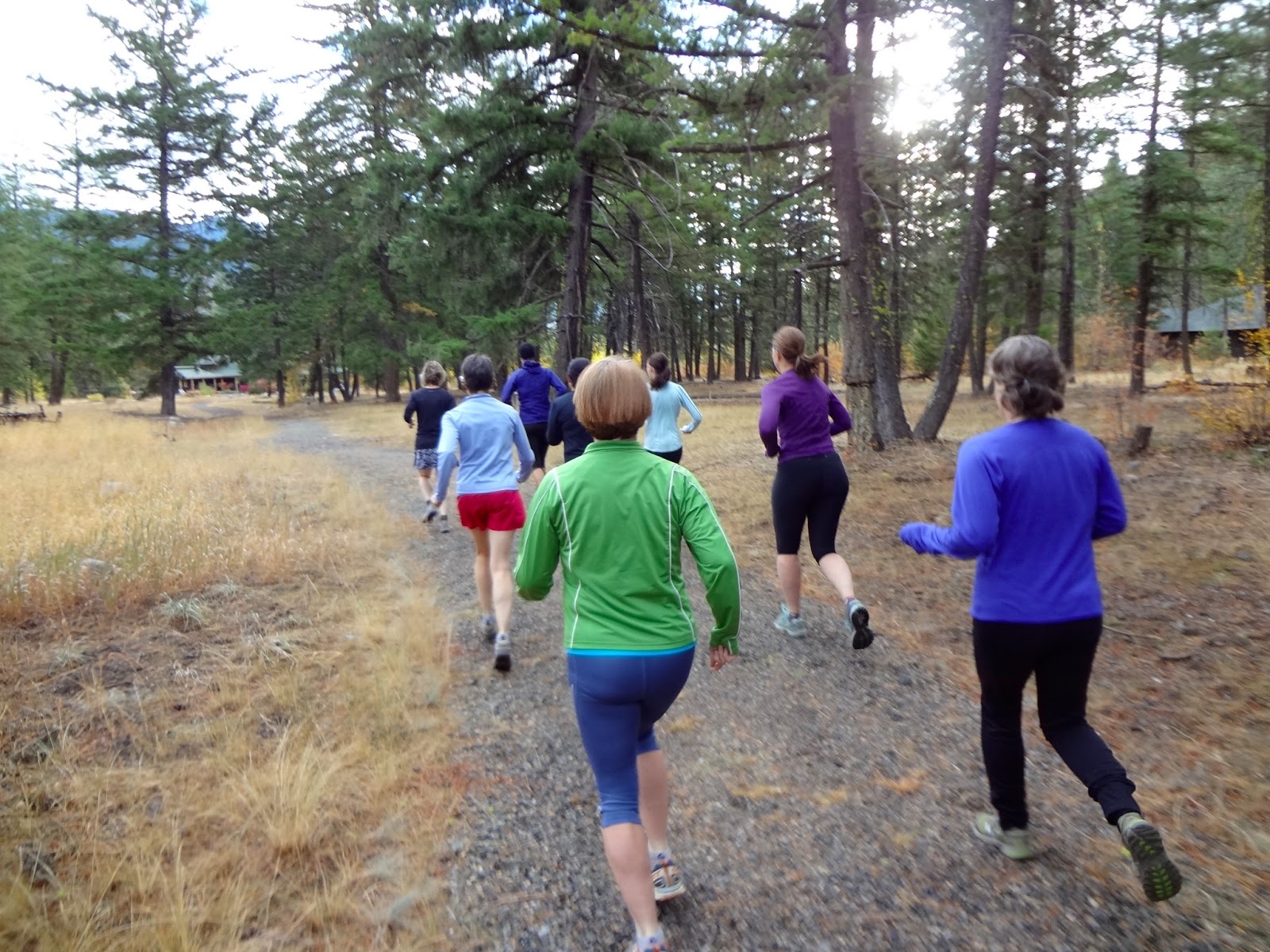
Beginning Running Class
 |
| Learning to activate stabilizing muscles |
Wednesday, February 27, 2013
Fueling for 50km (skiing, that is!)
What do you eat?
It's probably one of the most-asked questions an endurance athlete gets. Whether it pertains to daily diet, how to stay lean, or how to fuel for training and events, people are quite consumed (so to speak) with what skiers and runners put in the tummy. And in truth they're worthwhile questions; lost is the athlete who doesn't eat well. For training, it can derail decent workouts into bonked disasters and poor recovery; for races, well...if you have never experienced the giant's hand come crashing down upon your skull, reducing you to a whimpering wet blanket who lusts only that enormous, pan-fried-in-butter Angus burger with blue cheese and caramelized onions... Ahem. Excuse me, I appear to be hitting the wall. Allow me to snarffle a gel, post-haste.
Ultrarunners who compete in 50 and 100-mile events have their own personal mixture of voodoo and peanut butter to fuel them through the grueling day, but skiers must rely on different means. Lacking the ability to carry hand-held bottles, or effectively use running packs such as those from Ultraspire, skiers must instead look to more compact fuels and sparse intake methods.
Last week I competed in the American Birkebeiner 50km ski marathon in Hayward, Wisconsin. I'm a sprinter by ability, so my foray into the ski marathon realm was a bit of an experiment. While I've spent plenty of long hours in overdistance workouts in the training months, it's rare that I spend more than 30 or 45 minutes in a ski race. So going into this race, I wanted to make sure I was prepared, food-wise. As a bigger athlete, I know I'm burning a lot of calories and while you can never replace calories lost in a 1:1 fashion during hard training or races, you must maintain some level of replenishment so your body doesn't enter a state of catabolism (scavenging muscle tissue) or just simply shutting down (i.e. cramping, bonking, general unpleasantness).
My plan for the race was simple: I had one 24oz bottle of strong HEED, and one gel per every half hour of racing. Also, I had a smaller bottle ready to be given to me by a friend at the 38km mark in the course. This was my "Go Juice" bottle, filled with flat Coke and a few crushed-up caffeine pills. This is an old marathoner's trick: your body, at the tail end of a long 2+ hour effort, is craving sugar in any form. Combine simple sugars such as those in soda with a jolt of caffeine (which not only serves as a stimulant but also helps to mobilize fat tissue for metabolism), and you've got a ready friend in your time of need. I should mention though, along with all fueling during races, please experiment with different drinks and foods during training before using them in races. The options I'm suggesting here might not work for you in the same way as me, either in terms of quantity or type of fuel.
Perhaps the most important thing to remember in fueling for anything, be it training or a race, is to be consuming calories BEFORE you start feeling the craving. Tim Noakes has a compelling new book which argues that we need far less liquids than we typically consume during race efforts. And yet, hydration aside, sports drinks offer a ready source of calories in an easy-to consume medium. I've read that your muscles can store up to 2500 calories in glycogen, which is ample for a two hour competition. However, completely draining your muscle glycogen stores to the bottom of the tank can't introduce good vibes. I'd rather end a race with a bit left in the tank, and save myself the bonk/cramp/crankiness.
Bottom line: for ski efforts lasting two to four hours, plan on 200-250 calories/hour of fueling. One Hammer Gel contains 90 calories, and a two-scoop bottle of HEED has around 200 calories, so consider taking a gel every half hour, and a few big swigs of HEED every fifteen minutes. I find that if I schedule it in this manner I remember to actually feed. Another way to do it is by kilometer; many ski marathon courses have kilometer signs, which allow you to break the course into sections. For the Birkie, I ate a gel every 10km, and took a few big slugs of HEED every 5km. Play around with these strategies and experiment with different foods and drinks. You'll find a sweet spot of fueling that helps you maintain a steady level of energy without introducing a heavy stomach or discomfort.
It's probably one of the most-asked questions an endurance athlete gets. Whether it pertains to daily diet, how to stay lean, or how to fuel for training and events, people are quite consumed (so to speak) with what skiers and runners put in the tummy. And in truth they're worthwhile questions; lost is the athlete who doesn't eat well. For training, it can derail decent workouts into bonked disasters and poor recovery; for races, well...if you have never experienced the giant's hand come crashing down upon your skull, reducing you to a whimpering wet blanket who lusts only that enormous, pan-fried-in-butter Angus burger with blue cheese and caramelized onions... Ahem. Excuse me, I appear to be hitting the wall. Allow me to snarffle a gel, post-haste.
 |
Last week I competed in the American Birkebeiner 50km ski marathon in Hayward, Wisconsin. I'm a sprinter by ability, so my foray into the ski marathon realm was a bit of an experiment. While I've spent plenty of long hours in overdistance workouts in the training months, it's rare that I spend more than 30 or 45 minutes in a ski race. So going into this race, I wanted to make sure I was prepared, food-wise. As a bigger athlete, I know I'm burning a lot of calories and while you can never replace calories lost in a 1:1 fashion during hard training or races, you must maintain some level of replenishment so your body doesn't enter a state of catabolism (scavenging muscle tissue) or just simply shutting down (i.e. cramping, bonking, general unpleasantness).
 |
| Check out the "Jingle-Gels" attached to the drink belt. |
Perhaps the most important thing to remember in fueling for anything, be it training or a race, is to be consuming calories BEFORE you start feeling the craving. Tim Noakes has a compelling new book which argues that we need far less liquids than we typically consume during race efforts. And yet, hydration aside, sports drinks offer a ready source of calories in an easy-to consume medium. I've read that your muscles can store up to 2500 calories in glycogen, which is ample for a two hour competition. However, completely draining your muscle glycogen stores to the bottom of the tank can't introduce good vibes. I'd rather end a race with a bit left in the tank, and save myself the bonk/cramp/crankiness.
Bottom line: for ski efforts lasting two to four hours, plan on 200-250 calories/hour of fueling. One Hammer Gel contains 90 calories, and a two-scoop bottle of HEED has around 200 calories, so consider taking a gel every half hour, and a few big swigs of HEED every fifteen minutes. I find that if I schedule it in this manner I remember to actually feed. Another way to do it is by kilometer; many ski marathon courses have kilometer signs, which allow you to break the course into sections. For the Birkie, I ate a gel every 10km, and took a few big slugs of HEED every 5km. Play around with these strategies and experiment with different foods and drinks. You'll find a sweet spot of fueling that helps you maintain a steady level of energy without introducing a heavy stomach or discomfort.
Subscribe to:
Posts (Atom)